


Page 22 - SRPSKO DRUŠTVO ISTRAŽIVAČA RAKA
P. 22
PATIENT POINT OF VIEW


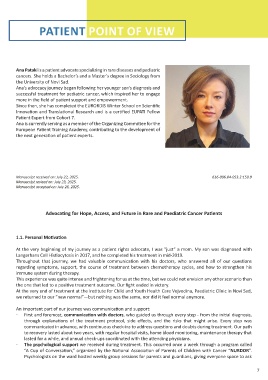
        Ana Pataki is a patient advocate specializing in rare diseases and pediatric
        cancers. She holds a Bachelor’s and a Master’s degree in Sociology from
        the University of Novi Sad.
        Ana’s advocacy journey began following her younger son’s diagnosis and
        successful treatment for pediatric cancer, which inspired her to engage
        more in the field of patient support and empowerment.
        Since then, she has completed the EURORDIS Winter School on Scientific
        Innovation and Translational Research and is a certified EUPATI Fellow
        Patient Expert from Cohort 7.
        Ana is currently serving as a member of the Organizing Committee for the
        European Patient Training Academy, contributing to the development of
        the next generation of patient experts.


        Manuscript received on: July 22, 2025.                                                 616-006.04-053.2:159.9
        Manuscript revised on: July 23, 2025.
        Manuscript accepted on:  July 26, 2025.


                     Advocating for Hope, Access, and Future in Rare and Paediatric Cancer Patients


        1.1. Personal Motivation

        At the very beginning of my journey as a patient rights advocate, I was “just” a mom. My son was diagnosed with
        Langerhans Cell Histiocytosis in 2017, and he completed his treatment in mid-2019.
        Throughout  that  journey,  we  had  valuable  communication  with  his  doctors,  who  answered  all  of  our  questions
        regarding symptoms, support, the course of treatment between chemotherapy cycles, and how to strengthen his
        immune system during therapy.
        This experience was quite intense and frightening for us at the time, but we could not envision any other scenario than
        the one that led to a positive treatment outcome. Our fight ended in victory.
        At the very end of treatment at the Institute for Child and Youth Health Care Vojvodina, Paediatric Clinic in Novi Sad,
        we returned to our “new normal”—but nothing was the same, nor did it feel normal anymore.

        An important part of our journey was communication and support:
           ͳ  First and foremost, communication with doctors, who guided us through every step - from the initial diagnosis,
            through  explanations  of  the  treatment  protocol,  side  effects,  and  the  risks  that  might  arise.  Every  step  was
            communicated in advance, with continuous check-ins to address questions and doubts during treatment. Our path
            to recovery lasted about two years, with regular hospital visits, home blood monitoring, maintenance therapy that
            lasted for a while, and annual check-ups coordinated with the attending physicians.
           ͳ  The psychological support we received during treatment. This occurred once a week through a program called
            “A Cup of Conversation,” organized by the National Association of Parents of Children with Cancer “NURDOR”.
            Psychologists on the ward hosted weekly group sessions for parents and guardians, giving everyone space to ask


                                                                                                                   7

